Know before you deposit: Curated DeFi vaults explained
Onchain lending is a popular way to generate yield. Depositors seeking yield generally have two options: interact with lending markets directly or entrust their deposits to a curator. Many lending protocols exist, and each offers different markets with dynamic rates and risks. A depositor who interacts directly with a protocol/market must vigilantly monitor shifting yield and risk. Curators, or onchain fund managers, offer to relieve this burden in exchange for a fee. This article covers the factors a depositor should consider when selecting a curator.
Picking a curator often feels like a leap of faith. After all, you’re basically trusting a stranger's sense of judgment with your capital. When seeking the best risk-adjusted yield in lending protocols, you need to know how to pick a curator based on their past onchain decisions. I’ve specialized in DeFi risk for 4+ years, and this piece guides you on how to evaluate and choose curators based on what they've actually done, not the curator’s brand.
Depositors pay for the curator’s risk judgment
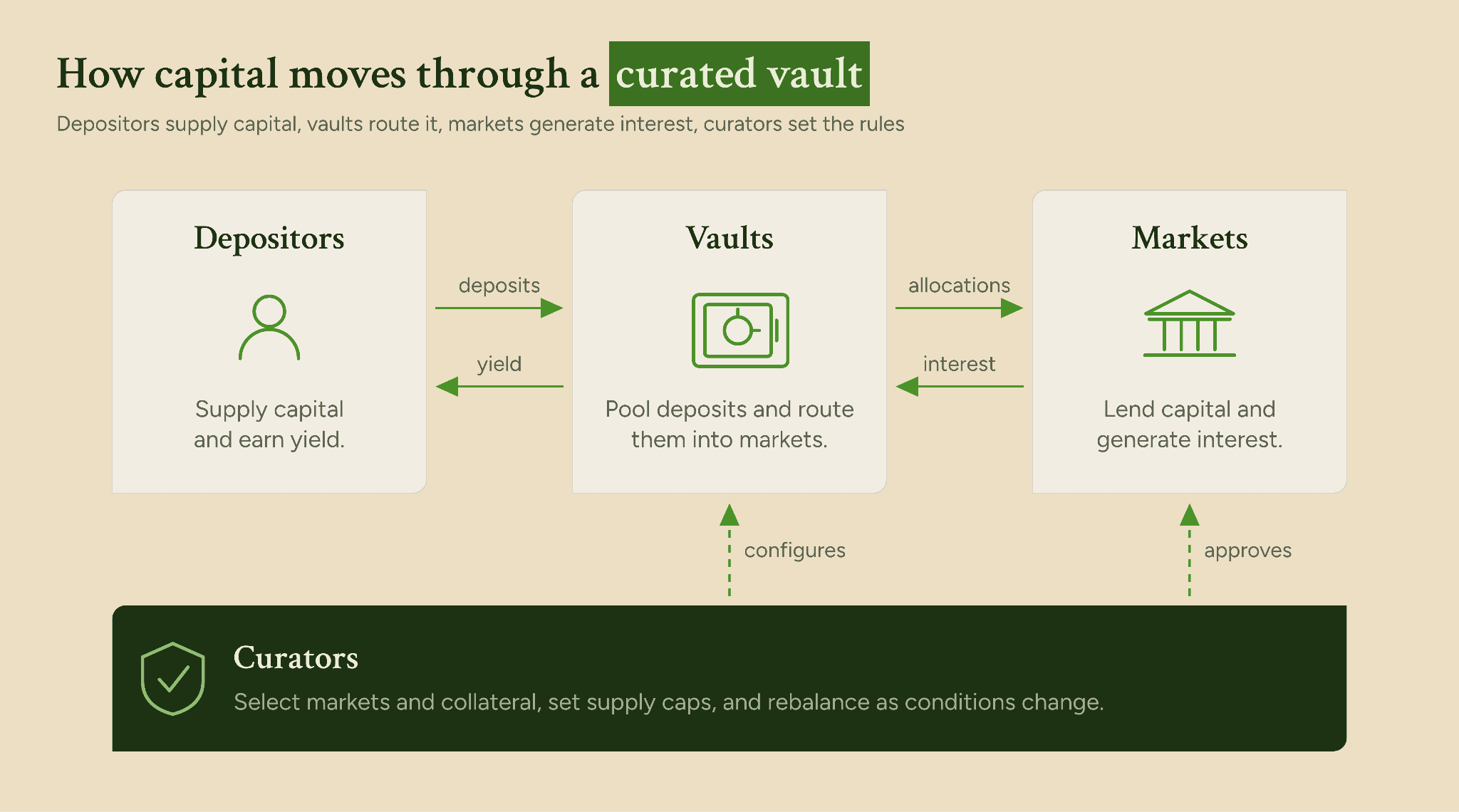
On lending protocols like Morpho, a curator manages an ERC-4626 vault that routes depositor capital into lending markets. Each curator selects which markets the vault enters, defines which collateral the vault accepts, sets supply caps, manages concentration, and rebalances as conditions change. Depositing into a vault means delegating those decisions to a specialist.
What depositors really pay for is the curator’s risk judgment: which collateral can withstand stress, which oracles produce reliable prices, and how much exposure the vault will take. That judgment depends on accurate, current data about liquidity, oracle design, liquidation mechanics, and market structure. Because this information is fragmented across protocols and chains, evaluating it requires time and expertise.
Curators are DeFi’s version of portfolio managers in traditional finance and may earn management or performance fees. Today, curator management fees are generally zero, while performance fees vary by vault and are more common on riskier strategies. This creates a principal-agent problem: curators can earn more from risk without bearing depositor losses. Reputation and transparency help keep those incentives in check.
Reputation and transparency are tightly coupled in DeFi. Reputation in DeFi is built on past onchain performance, where every allocation, every avoided blowup, and every position held through a stressed market is visible to anyone.
Overview of leading curators
Morpho V2 vaults on Base hold around $1B in TVL, and close to 94% of it sits with two curators: Steakhouse and Gauntlet, according to Cambrian data. Most of the TVL is in USDC.
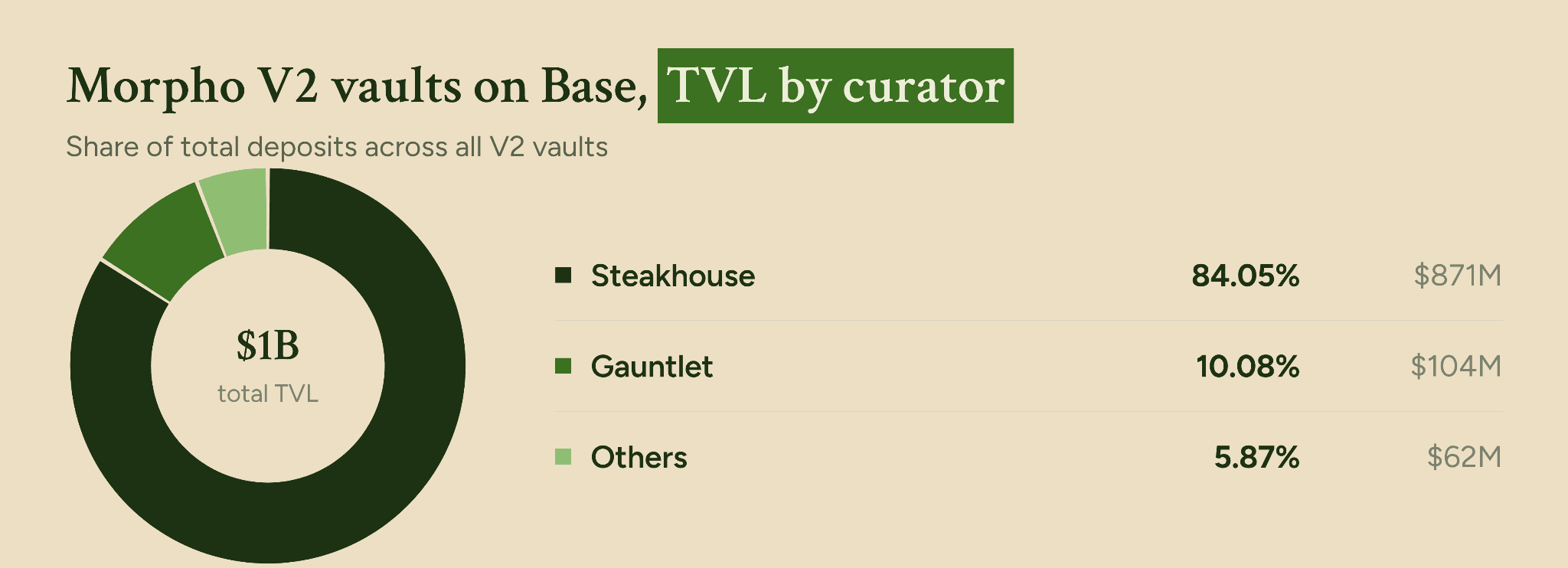
With that much capital in so few hands, what these curators publish about their own frameworks is worth reading closely. Each runs a different strategy.
Steakhouse allocates to Morpho and Kamino. They pick their markets using a risk rating scored from AA down to C. Their rating depends on three factors: 1) the asset, 2) the platform, and 3) the market parameters like the oracle mechanism, correlation of trading pairs, liquidity depth, and credit enhancements. Tight market parameters can partially compensate for riskier assets. For example, a risky asset wrapped in a conservative loan-to-value, a careful oracle, and a well-correlated pair can still clear, but a safe asset exposed through an aggressive market configuration may not. Finally, a runtime layer monitors for oracle divergences, depegs, or governance changes, for example.
Gauntlet advised lending protocols on risk parameters years before becoming a curator. Gauntlet uses three primary factors for selecting markets:
- how much can be swapped onchain without excessive slippage, which determines whether liquidators can clear bad debt
- the historical volatility of the collateral, which drives the loan-to-value
- how manipulation-resistant the oracle is, which is important to protect from third-party attacks
Vaults are then sorted into tiers, from a conservative tier that targets minimal insolvency risk under extreme conditions, to a balanced one, to a frontier tier that takes on higher-volatility markets in exchange for higher yield. The tier is, in effect, a published statement of risk appetite, and the underlying allocations validate those claims.
Vaults carry liquidity, volatility, and bad debt risk
Curators manage vaults, and every vault faces the same set of lending risks for depositors:
-
Liquidity. When utilization runs hot, most of the supplied assets are out on loan, and the capacity to withdraw immediately shrinks. Careful borrow capacity management reduces this, but it never disappears.
-
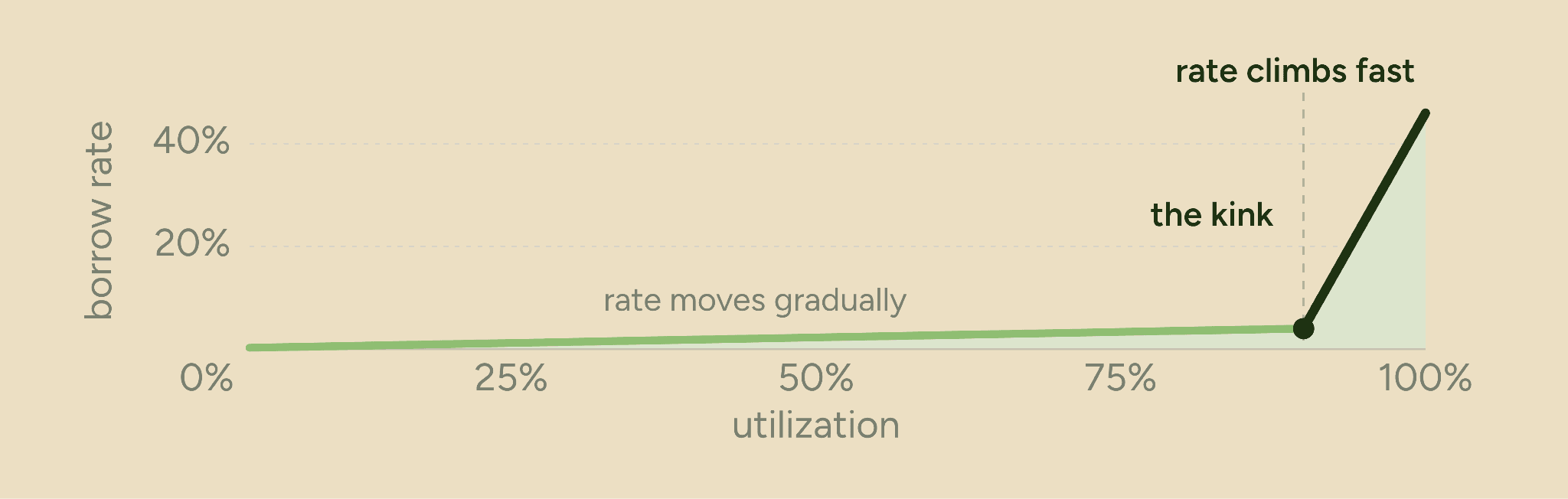
Rate volatility. Lending markets in general price borrowing on a “kinked” curve. Below the kink, the rate moves gradually with utilization, and above it, the rate climbs fast.
- Bad debt. When a borrower position is not liquidated in time during a sharp move, the uncovered shortfall is socialized across all lenders in that market, and while fast liquidator action narrows the window, it cannot guarantee the window closes to zero.
Curators can't eliminate all these risks. They can only decide how much of each risk to accept, market by market.
Vaults allocate to markets, which have their own risks
Market selection drives most risk. Every market has a collateral asset and an attached price feed, aka an oracle. The collateral asset is the biggest factor in how aggressive a vault is, and the price feed determines loan health and liquidation eligibility. Hardcoded prices, single-source feeds, and thin-liquidity feeds are failure modes that can compromise a vault that otherwise looks healthy.
Market concentration decides how far one failure travels. A vault spread across many markets can absorb a single market's failure without systemic loss, and a concentrated vault cannot. For example, Gauntlet USDC Prime Vault on mainnet allocates across seven markets, and the two largest hold 94% of the capital:
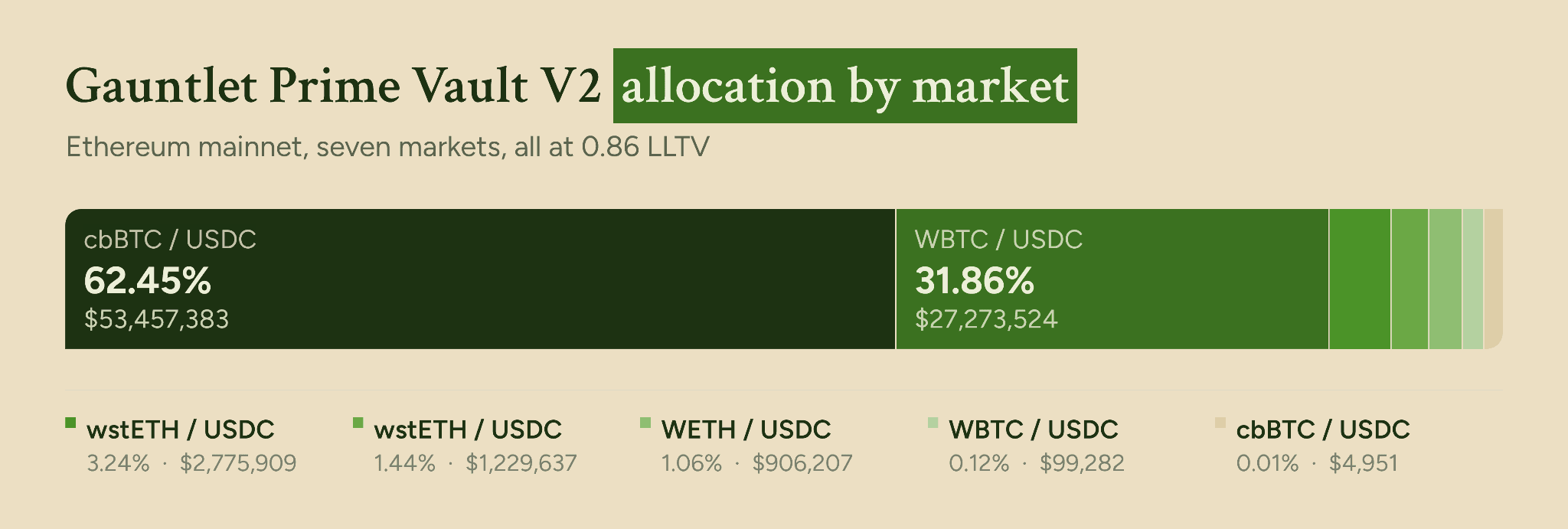
Source: Cambrian data, August 2026.
Access control decides who can move the capital and who can change the rules. Those permissions are typically split across multisigs, and the number of signatures each needs determines how fast anything can change. A single wallet that holds every role is a single point of failure.
Both curators and depositors require data to identify opportunities and risk
A depositor needs the same information as curators: market liquidity, oracle configurations, and exposure concentration. Assembling that view is hard because the data sits across protocols in inconsistent formats, and it goes stale quickly because allocations move with every deposit and withdrawal. Anyone who wants to know where their money stands has to rebuild that picture instead of looking it up.
The Cambrian API solves the data problem by replacing fragmented data pipelines with a single source of financial intelligence. It provides structured, up-to-date onchain data and a consistent way to read positions, collateral, oracle configuration, and concentration across protocols. Cambrian does not execute on behalf of users; that decision stays with the depositor.
My name is Matias. I have spent the last few years studying DeFi, and I publish research regularly. If you want to talk about DeFi data or about what I’m contributing at Cambrian Network, find me as @0xEulersID on X, or see more on @CambrianNetwork.
About Cambrian
Cambrian is the financial intelligence layer for agents and institutions. Our API delivers real-time and historical blockchain data, covering yield, liquidity positions, risk, trading activity, and market sentiment, for agentic and institutional DeFi applications. Founded in 2024, Cambrian is backed by Polychain Capital, Franklin Templeton, a16z crypto, Flow Traders, Selini Capital, and others.